
Senior Transportation
Rides for Seniors Across Scottsdale, Door Through Door
Giving up the keys is never really about the car. It is about the calendar: the appointments, the grocery run, church, lunch with friends. With Seniors Helping Seniors® in-home care services a Caregiver drives your parent there, comes inside with them, waits, and brings them home.
Quick answer
What is senior transportation, and where do you drive?
Senior transportation from Seniors Helping Seniors® Scottsdale is a Caregiver who drives an older adult to where they need to be, walks in with them, waits, and brings them home, across Scottsdale, Paradise Valley, Fountain Hills, and the northeast and north Phoenix neighborhoods we serve. It covers doctor and dental appointments, treatment that repeats every week for months, the grocery run, church, the hair appointment, lunch with friends, and the airport. It is non-medical: not an ambulance, not medical transport, and not a wheelchair-lift vehicle.
Key facts
- What it is
- Companion driving, door through door
- Typical trips
- Appointments, treatment courses, errands, church, social plans, the airport
- How it is booked
- One trip when you need it, or the same day and time every week
- Who drives
- A Caregiver who is a senior too, the same one whenever possible
- What it is not
- Non-medical. Not an ambulance, not medical transport, and not a wheelchair-lift vehicle
- Reach us
- Mon-Fri, 8 AM to 6 PM · 24/7 for emergencies · (480) 674-5400 · info@shsscottsdale.com
The Car Keys
What changes when the car keys go?
Nothing dramatic has to happen first. Not a fall, not a diagnosis. A driver's license that quietly does not get renewed, and a week that has to be rebuilt around it.
The car goes, and then the Thursday lunch goes. Then the standing appointment at the salon, then the six month check-up nobody wants to move again, then church. Within a season the week has emptied out, and the family reads that as decline when a good part of it is just logistics.
It is worth saying plainly how big a loss this is. Handing over the keys is not an inconvenience. It is the end of going anywhere without asking somebody first, and most people feel it as exactly that. Pretending otherwise is why so many families get a flat no when they raise it.
A systematic review published by the AAA Foundation found that
driving cessation almost doubled the risk of increased depressive symptoms in older adults
So a ride is not a consolation prize for a surrendered driver's license. It is the piece that keeps the doctor, the hairdresser, the friends and the Sunday service, which is most of what anyone means by independence in the first place.

If it is the calendar you are worried about, that is a phone call, not a decision. Call (480) 674-5400, or ask for a free care visit, and we will work out which trips actually need somebody along and which ones do not.
Door Through Door
What does a ride actually look like?
Door to door means somebody stops a car outside a building. Door through door means the same Caregiver stays with your parent from their own front door to the exam room door and back again. That is the whole difference, and it is the part an app cannot book for you.
-
Stop 1
The pickup
At the door at the agreed time, with the address written down and enough slack in the schedule for parking.
-
Stop 2
The drive
Company rather than silence, from somebody who knows why this particular appointment matters.
-
Stop 3
Walking in
Into the lobby, up to the desk, through the clipboard, and down the long corridor if that is what it takes.
-
Stop 4
The wait
We stay. Nobody has to make a second call to arrange a ride home, and nobody sits outside on a bench.
-
Stop 5
Home again
The pharmacy counter, the few groceries you asked for on the way, and a short note to you afterward.
If your parent wants it, the Caregiver can come into the room, write down what the doctor said, and pass it on, so the family is not rebuilding the instructions from a printout that evening. If they would rather we waited in the corridor, we wait in the corridor. It is their appointment.
The same person, every time. Rides are easiest to staff, and much easier for your parent, when they are a standing arrangement rather than a scramble. It is the same reason a companionship visit works better in the second month than the first: they are not spending the drive working out who you are. Tell us on the first call whether this is one trip or a standing one: (480) 674-5400.
The Destinations
Where do the rides go?
You probably have one appointment in mind. The rest of this list is what the same ride can cover.
Medical
Doctors, dentists, the eye exam, the lab
Primary care, the specialist across the Valley, the dentist, the eye doctor, the blood draw, and the pharmacy counter on the way home.
The long courses
Treatment that repeats for months
Infusion, radiation, cardiac rehab, therapy sessions twice a week until March. These are the ones that quietly wear a working family down, because they do not end after one Tuesday.
The ordinary week
Groceries, the bank, church, the salon
The Saturday shop, the errand nobody can do over the phone, the standing hair appointment, the service they have not missed in forty years. Rides also pair with the errands service, for the weeks when the list matters more than the outing.
The good ones
Lunch, the game, the garden club
A friend's kitchen, a grandchild's game, a museum, a funeral, a wedding. Nobody would file these under care, and they are the first trips to disappear when the driving stops.
The long haul
The airport run
The early flight out of Sky Harbor and the pickup when they land again, which is the trip you would otherwise be asking a neighbor to take on.
A Veteran's appointments belong on this list too, and they are usually the longest morning of the month. We can drive them. What the VA itself pays for is a separate question, and the two benefits that do most of the work here are set out on our Veterans page.
Honest Limits
What we do not do
It saves everybody a difficult morning if you know these four things before you book, rather than at the curb on the day of the appointment.
-
We are not medical transport
No ambulance, no stretcher, no oxygen, no clinical treatment on the way. If your parent needs attention during the trip itself, this is the wrong service, and in an emergency the number is 911.
-
We do not operate a wheelchair-lift vehicle
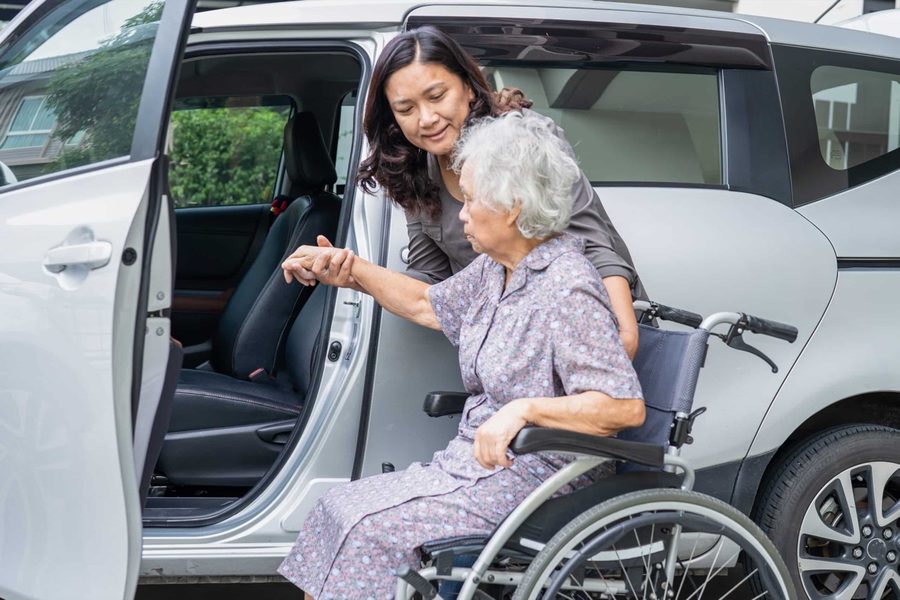
What a Caregiver can offer is a steadying hand and enough time for somebody who is able to move into an ordinary car seat. If your parent uses a wheelchair or is unsteady on a transfer, say so on the first call. We will tell you plainly what we can manage, and point you at something that fits better if we cannot.
-
We are not a ride-hailing app
What you are booking is the part either side of the drive: walking in, sitting through the wait, and coming home again with them. If all your family needs is a lift and nobody has to come inside, tell us that on the first call. An app will usually do that for less, and we would rather point you at it than sell you an hour you do not need.
-
We do not speak for your parent
A Caregiver can take notes and pass on what the doctor said when your parent asks them to. They do not make decisions, they do not consent to anything on anyone's behalf, and they give medication reminders, never doses.
Public and nonprofit ride programs also run in the Valley, and for some families one of them is the better answer. We do not set their eligibility rules, fares or boundaries and those do change, so check with the program directly before you build a course of appointments around one. If you would rather talk it through first, call (480) 674-5400.
Getting started
How does care start?
- 1
You call, or book a free care visit.
Call (480) 674-5400 or Request a Free Care Visit. You reach Andy or his staff, not a call center.
- 2
We visit the home.
About an hour, free, no pressure. We meet your loved one, walk the house, talk routines, and check whether GUIDE or VA benefits might apply.
- 3
We match the Caregiver.
Personality, interests, pace, schedule. First visits usually happen within days, and we check in afterward to make sure the match fits.
FAQ
Questions families ask about rides
Does the Caregiver stay during the appointment, or drop off and come back?
They stay. The same Caregiver drives your parent there, walks in with them, sits through the wait, and drives them home, which is what door through door means. There is no second phone call to arrange a ride back, and nobody is left on a bench outside a clinic with a phone they do not like using.
Can the Caregiver take notes and tell the family what the doctor said?
Yes, when your parent asks them to. It is their appointment and their information, so nothing comes to the family unless they say so. When they do say so, you get the instructions, the next date, and what actually happened in the room, instead of rebuilding it from a printout that evening.
Can you drive the same appointment every week for months?
Yes, and that is the arrangement that helps most. A course of infusion, radiation, rehab or therapy sessions runs for weeks, and a standing day and time is easier for us to staff and gives your parent the same Caregiver every visit. Tell us the schedule as soon as the clinic hands it to you.
Whose car does the ride happen in?
That one we would rather answer on the phone than guess at in a sentence here, because it turns on the trip and on what your parent can get in and out of comfortably. Raise it when you call (480) 674-5400, or at the free care visit, and we will tell you exactly how your rides would work before anything is booked.
What does a ride cost, and is the waiting time charged?
We do not publish rates on the site. Tell us the appointment, the day, and roughly how long it usually runs, and we will walk you through what it would cost on the phone at (480) 674-5400 or at the free care visit, before anyone commits to anything. Waiting time is one of the things to settle in that conversation, so put it on your list of questions.
Do you provide medical transport or a wheelchair-accessible vehicle?
No to both. Transportation from Seniors Helping Seniors® Scottsdale is non-medical, so there is no clinical treatment on the way and it is not an ambulance, and we do not operate a wheelchair-lift or wheelchair-accessible vehicle. A Caregiver can steady someone who is able to move into a car seat with a hand and a little time. If your parent uses a wheelchair, say so on the first call and we will be straight with you about whether we are the right ride.
How far do you drive, and where?
Rides run across Scottsdale, Paradise Valley, Fountain Hills, and the northeast and north Phoenix neighborhoods we serve, and out to appointments elsewhere in the Valley when that is where the doctor is. Tell us where the appointment is when you call (480) 674-5400 and we will tell you whether we can cover it.
Transportation from Seniors Helping Seniors® Scottsdale is non-medical companion driving. It is not an ambulance and not a medical transport service, and no clinical treatment is given on the way. In an emergency, call 911. Anything a Caregiver hears at an appointment belongs to your parent, and it reaches the family only when they ask us to pass it on.
 Andy Lask, Owner Meet Andy →
The First Ride
Tell us where the appointment is.
Give us the date, the clinic, and the time they need to be in the chair, and we will tell you what the ride would look like and what it would cost.
Asking about one appointment does not commit you to a schedule, and it does not mean anybody is giving anything up.
There is no form to fill out. Andy and his staff answer Mon-Fri, 8 AM to 6 PM, and 24/7 for emergencies. Emails get a reply in under 4 hours.